

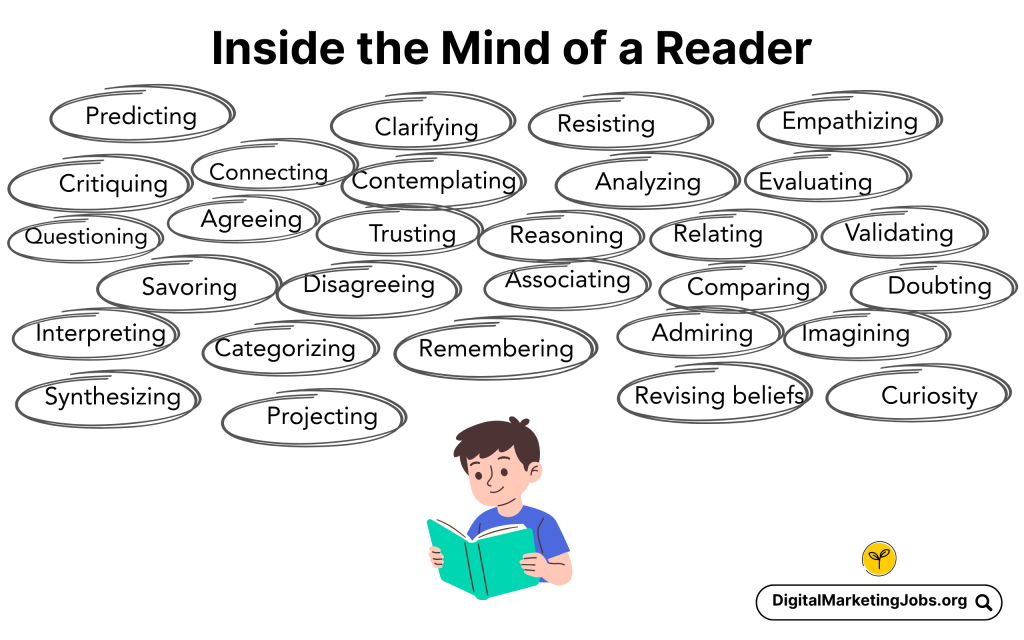
- Questioning – asking “Why did this happen?” or “What’s the author trying to say?”
- Agreeing / Disagreeing – comparing the author’s ideas with one’s own beliefs.
- Contemplating – pausing to reflect or connect ideas to personal experiences.
- Reasoning – forming logical links between cause and effect.
- Analyzing – breaking down complex ideas, structures, or motives.
- Evaluating – judging the facts, truth, and quality of what’s written.
- Comparing – relating it to other books, experiences, or ideas.
- Interpreting – uncovering meaning based on one’s own knowledge.
- Synthesizing – combining new ideas with existing knowledge.
- Predicting – anticipating what will happen next.
- Critiquing – evaluating discrepancies in the author’s argument.
- Connecting – relating ideas to one’s own experiences.
- Clarifying – rereading or rethinking to gain a clear understanding.
- Imagining – visualizing scenes, opportunities, and possibilities.
- Associating – connecting one idea with another.
- Categorizing – grouping ideas and recognizing patterns.
- Validating – verifying facts and logic against existing information.
- Empathizing – feeling what the characters or author feel.
- Relating – seeing oneself in the story or message.
- Resisting – rejecting an idea based on one’s worldview.
- Admiring – feeling inspired by the author or character.
- Curiosity – seeking to uncover hidden details or deeper truths.
- Doubting – questioning whether something is factually accurate or viable.
- Trusting – accepting the author’s world or logic as credible.
- Savoring – enjoying beautiful stories or insights.
- Remembering – recalling similar experiences or previous lessons.
- Projecting – imagining oneself in the story or situation.
- Revising beliefs – changing one’s inner worldview based on new knowledge.
“A reader lives a thousand lives before he dies. The man who never reads lives only one.” — George R.R. Martin